


Folks, on Wednesday we published Alex Spiro Wants to Go Into Business. Let’s Talk About His Business History. Alex Spiro, Elon Musk’s lawyer and still a Quinn Emanuel partner, has told The Tufts Daily he is “still exploring what he can do with his life and with his career outside of law.”
So we went back into the archive.
These emails come from the BHR whistleblower archive we’ve been reporting on since 2023, the trove that came out of BHR’s “263” email servers. Spiro’s name appears in more than 200 messages, most of them routine. Most of what follows has never been published.
Quotes are verbatim. Times are Eastern.
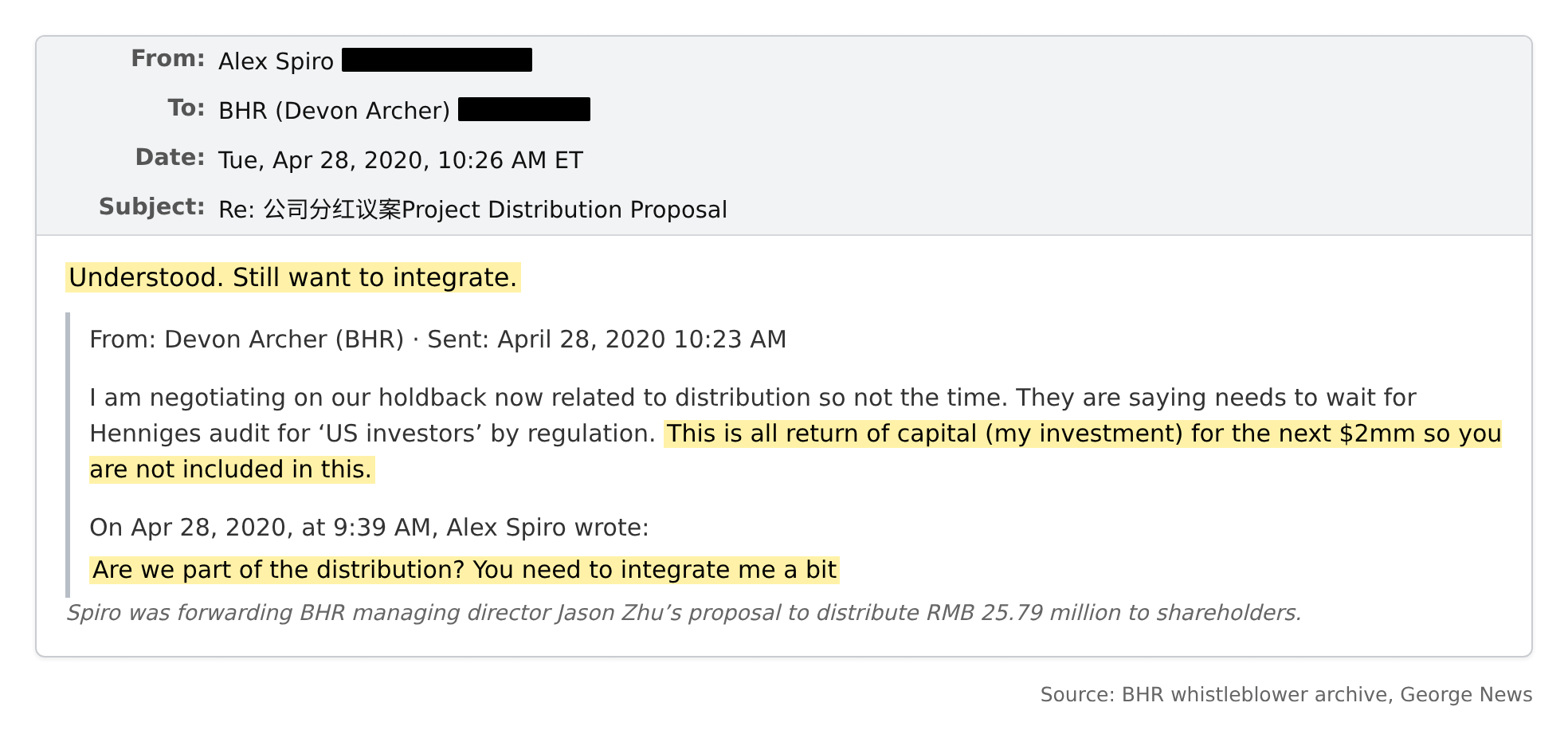
“Are we part of the distribution?”
On April 22, 2020, BHR managing director Jason Zhu sent the board a “Project Distribution Proposal.” It would pay shareholders 100% of the company’s preliminarily audited 2019 distributable profits. Total: RMB 25.79 million. Hunter Biden’s lawyer, George Mesires, was copied on the thread. Hunter’s Skaneateles LLC still held 10% of BHR, as we reported in Part II.
At 9:39am on April 28, Spiro forwarded it to Archer with one line:
“Are we part of the distribution? You need to integrate me a bit”
Archer replied at 10:23am:
“I am negotiating on our holdback now related to distribution so not the time. They are saying needs to wait for Henniges audit for ‘US investors’ by regulation. This is all return of capital (my investment) for the next $2mm so you are not included in this.”
Spiro, three minutes later:
“Understood. Still want to integrate.”
Read that again. Two months into his BHR directorship, he asked whether “we” were part of the payout.
To be fair, Archer told him plainly he wasn’t included. We found no payment, invoice or share transfer to Spiro anywhere in the archive. “Integrate” may just mean he wanted a bigger role.
On June 10, Archer sent Spiro a “document that requires your signature to close out latest asset sale.” At 1:01pm, Spiro’s Quinn Emanuel assistant sent it back: “Please see attached from Alex.” It was a BHR written board resolution approving the 2019 audit report and “the Explanation on the Profit Distribution Proposal.” Spiro’s signature sits above his name on the signature page.
So where did the Ulysses share go? The paperwork answers that.
BHR’s board approved the final figure on July 31, 2020: RMB 23 million, not 25.79 million. The line for the Archer-linked shareholder reads: “Ulysses Diversified, Inc. 10% 2,300,000.00.” An August 26 dividend worksheet then deducts RMB 879,304 from Ulysses’ share to repay a USD 108,000 advance from a Xin Wang, leaving RMB 1,190,696. On August 31, BHR’s notice to Ulysses described “partial dividends amount of USD 191,231.34 in the first payment.” BHR’s Heng-Yin Zhang later told Archer: “The wire was made on September 9, 2020.”
And who is Ulysses? A CPA memo dated April 27, 2020, found in Devon Archer’s inbox, says that “Krista Archer owns and controls 100% of the authorized and issued shares of Ulysses Diversified, Inc.”
George News flagged that stake back in August 2023, sharing Wendell Husebo’s exclusive that Krista Archer held a ten percent stake in BHR Partners. The documents now show how it was paid for, and where the money went.
The money behind that stake came through the same company. A copy of Ulysses’ 2018 tax return reviewed by George News lists a “BHR Partners” investment of $215,955 at the end of 2018, and none at the start of the year. That is exactly the sum of two 2018 wires discussed in the BHR archive: $108,000 on January 12 and $107,955 on March 2. When the Archers’ accountant asked about them in September 2019, Devon Archer replied:
“That is correct. Those are both investments in BHR. We borrowed the funds from the partnership to make the investment so there should be no income / revenue associated with those loans but for Chinese regulatory reasons the funds need to come from the Ulysses account.”
A year later he told the same accountant: “The majority of the investment was actually made in 2014.” Either way, the paper trail for the board seat’s money runs through the Archers’ company. None of it is tied to Spiro.
We found no document showing any payment, share or fee going to Spiro. On the paper we have, the money went to Ulysses, and Ulysses is Krista Archer’s. That fits Archer’s answer: “you are not included in this.”
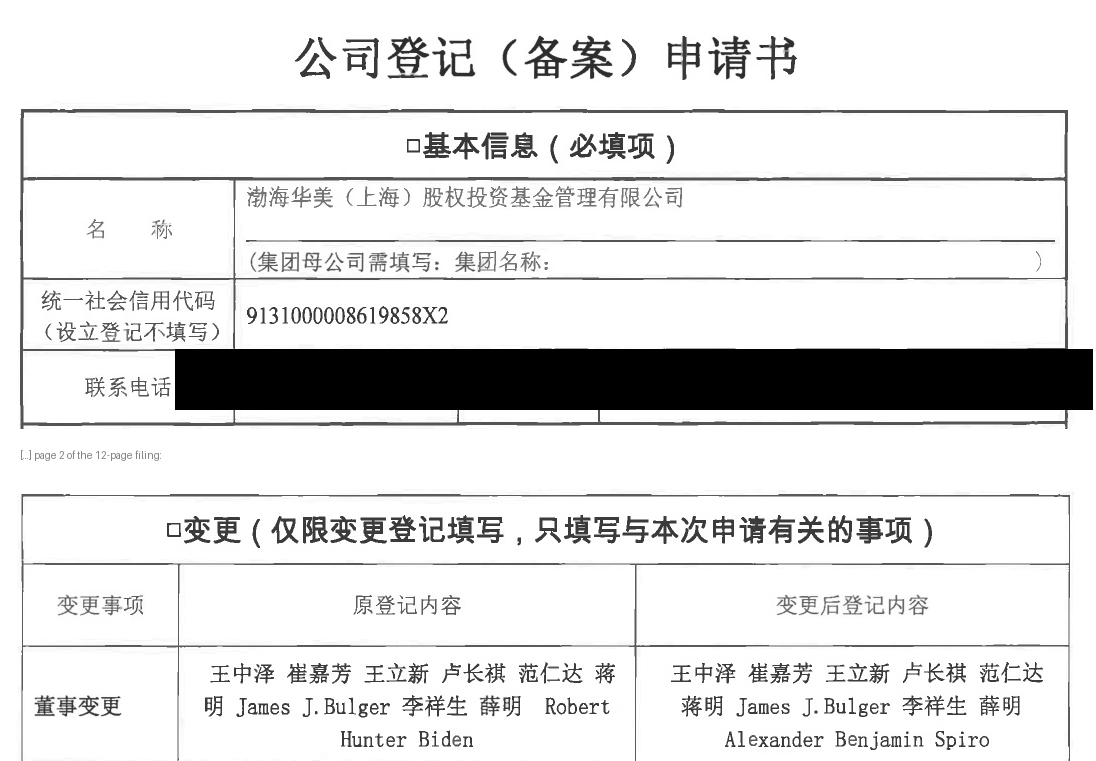
So how did Spiro get the seat? Two months before the “distribution” email, on February 28, 2020, his assistant sent Archer a signed Shanghai company registration form, again “from Alex.” Under “change of directors,” the old list ends with “Robert Hunter Biden.” The new list is the same, except the last name is “Alexander Benjamin Spiro.” The director page says he was “Ulysses Diversified, Inc 委派,” appointed by Ulysses, and carries a handwritten signature.
That’s the innocent reading, and it’s an ordinary one. The Archers’ company had a board seat and filled it with a friend who happened to be a famous lawyer. But it was Hunter Biden’s seat on the government filing, and Spiro signed for it.
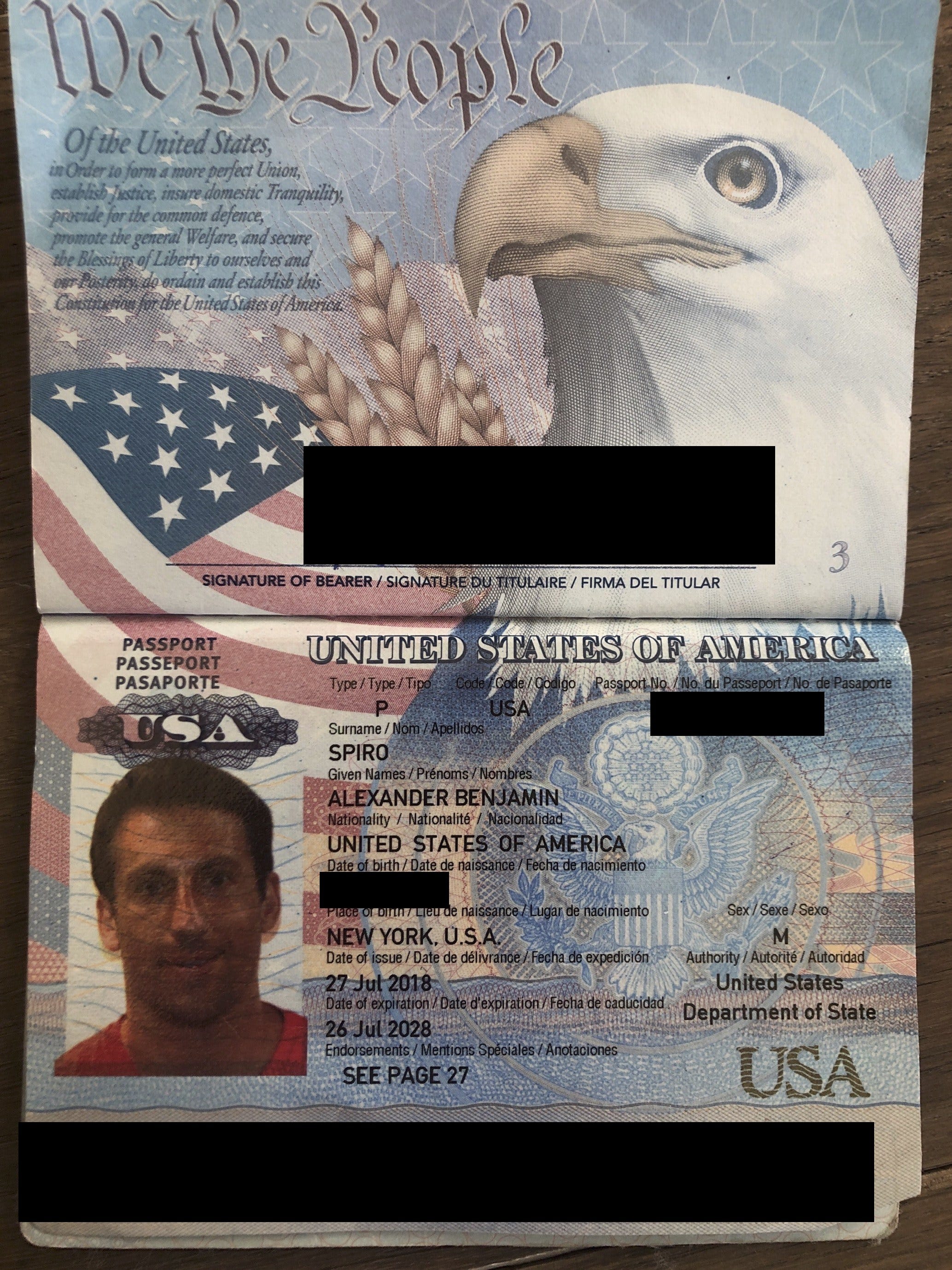
The exit is odder. In April 2023, BHR sent Archer a signing pack. In it was a Ulysses letter that “removes Mr. Alexander Benjamin Spiro as director” and appoints a George Guo, “effective as of the date hereof.” It is signed for “Dr. Krista Archer,” as “Authorized Person.” The date on it is “22. 12. 2021,” 16 months before it was sent for signature.
Backdating paperwork to match a decision already taken is common in corporate housekeeping, and the archive holds earlier draft removal letters from 2020. But it means that on paper, Spiro stayed a BHR director long after his November 2020 email saying he “never agreed for it to move forward.”
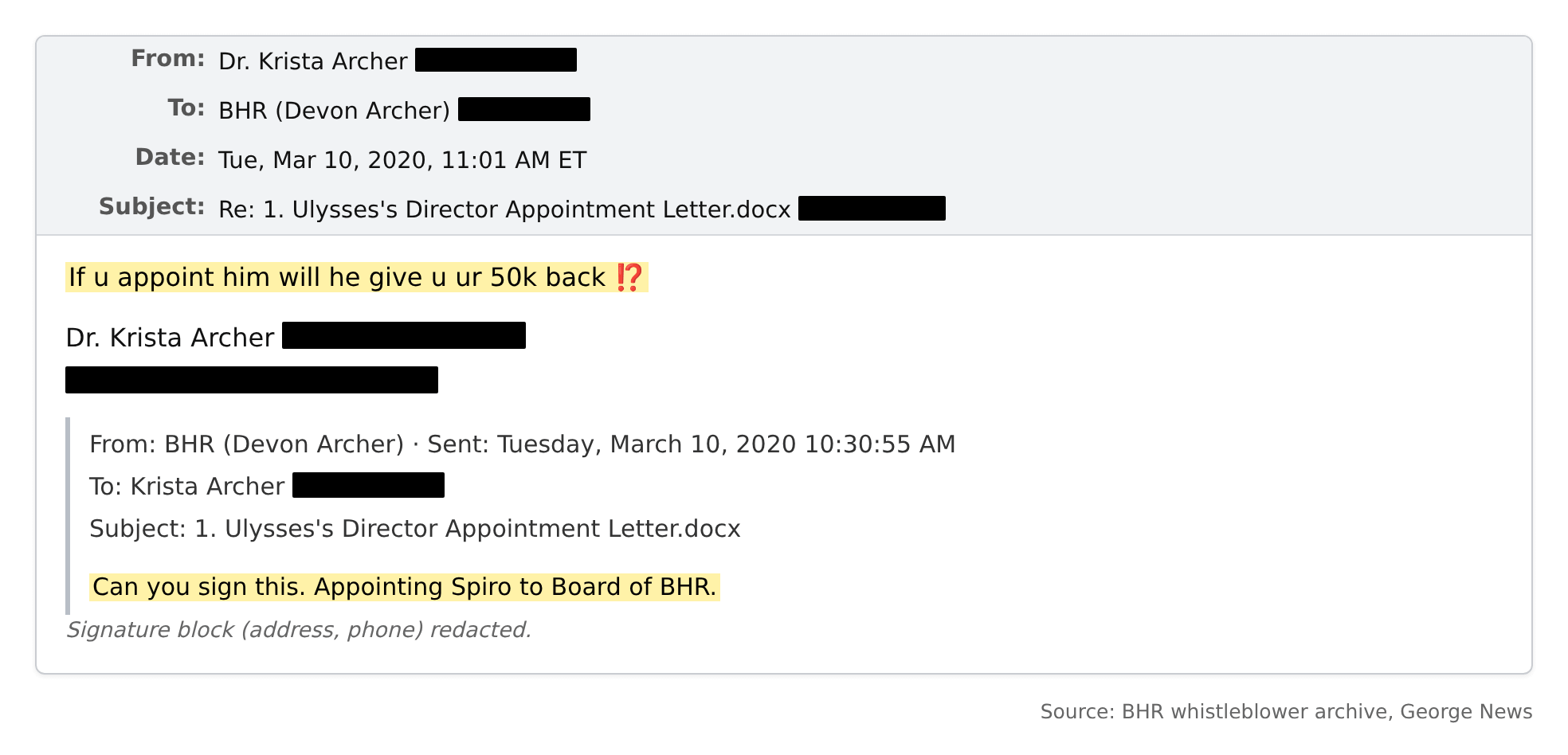
“Will he give u ur 50k back”
On March 10, 2020, at 10:30am, Archer emailed his wife, Dr. Krista Archer:
“Can you sign this. Appointing Spiro to Board of BHR.”
The attachment was “Ulysses’s Director Appointment Letter.” Ulysses Diversified, Inc. is the BHR shareholder we tied to the Archers in Part II.
At 11:01am she replied:
“If u appoint him will he give u ur 50k back ⁉️”
That’s the whole email. Nothing in the thread explains it. It could be a loan, an investment, a fee, or a joke. We don’t know, and we won’t guess. Spiro and Archer do.
“Tell me how I could be useful”
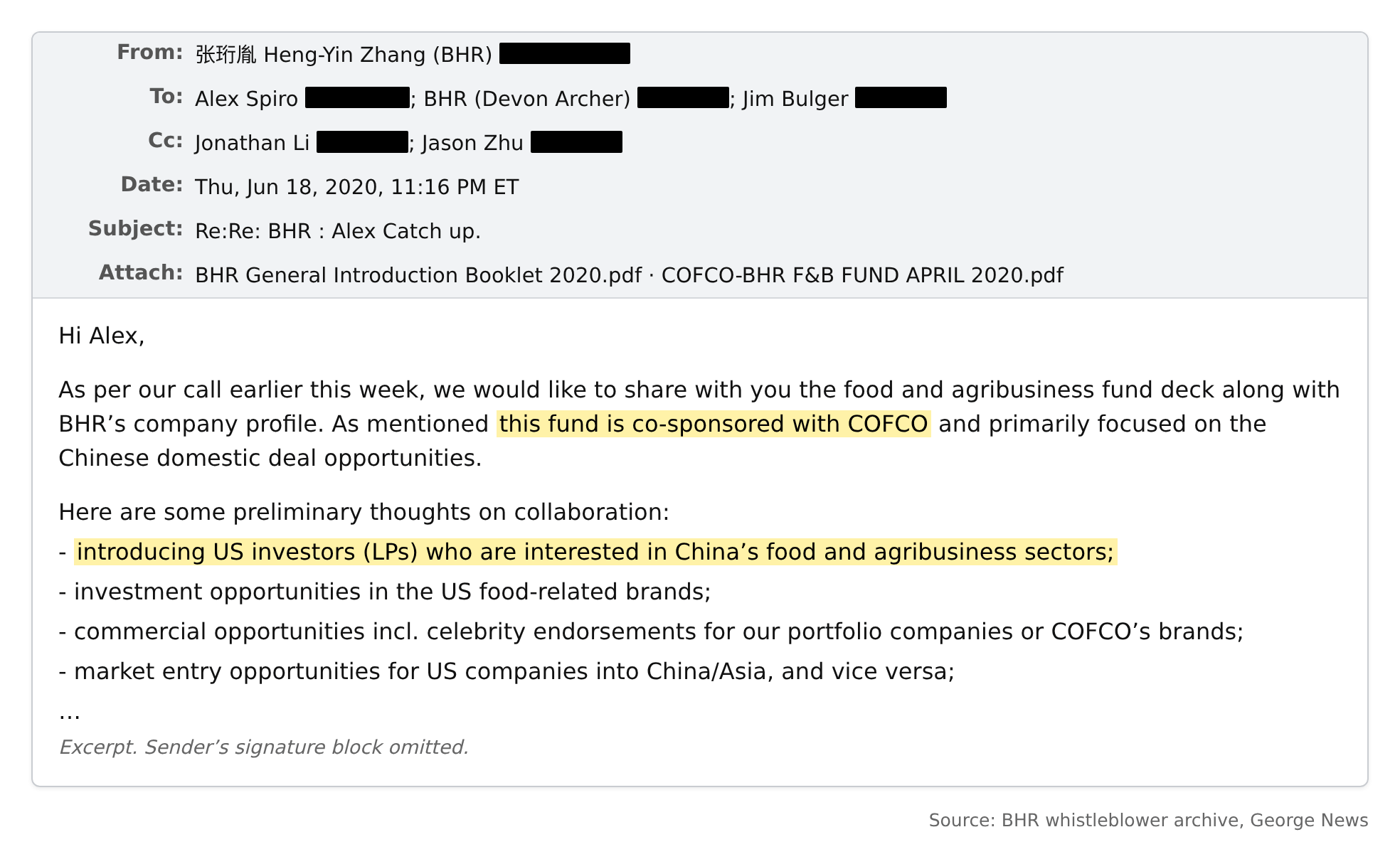
On June 10, 2020, Archer wrote to Spiro, BHR CEO Jonathan Li and Zhu: “Let’s set up a zoom call early next week to introduce Alex properly and to discuss current projects and objectives.”
At 11:16pm on June 18, BHR’s Heng-Yin Zhang followed up “as per our call earlier this week.” She sent BHR’s company profile and a pitch book for the COFCO-BHR Food & Beverage Buyout Fund. “This fund is co-sponsored with COFCO,” she wrote. The deck calls COFCO “the largest state-owned agribusiness enterprise.” Her ideas for collaboration began with “introducing US investors (LPs) who are interested in China’s food and agribusiness sectors.”
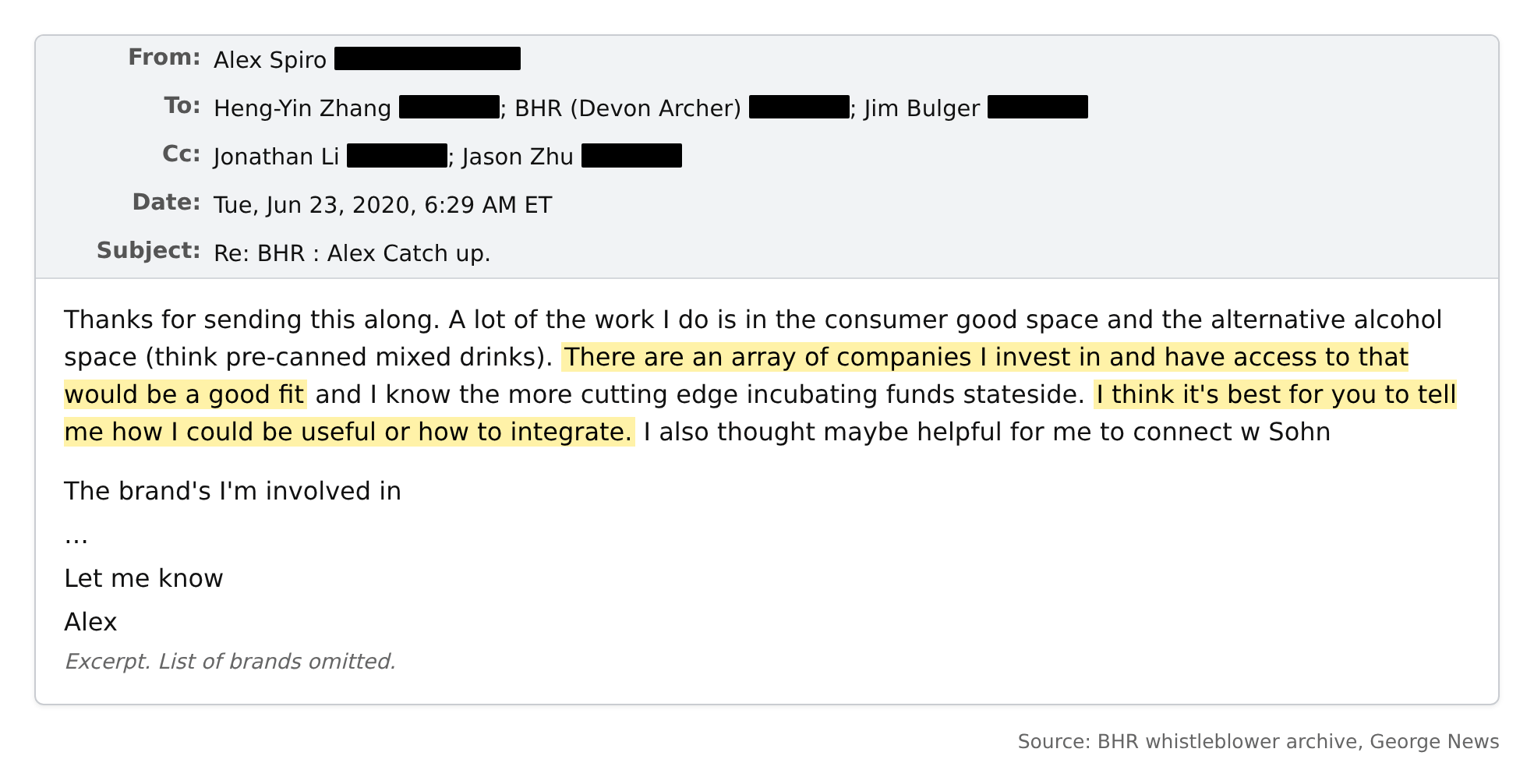
Spiro replied at 6:29am on June 23:
“A lot of the work I do is in the consumer good space and the alternative alcohol space (think pre-canned mixed drinks). There are an array of companies I invest in and have access to that would be a good fit and I know the more cutting edge incubating funds stateside. I think it’s best for you to tell me how I could be useful or how to integrate.”
Now hold that next to what Spiro wrote on November 2, 2020, replying to Archer’s October 30 email saying BHR had “explored the Advisory Board position”:
“Devon - thanks for confirming nothing moved forward (as I never agreed for it to move forward).”
That note is about an “Advisory Board position.” The June emails show a director being introduced “properly” to BHR’s CEO and asking how he could be useful. We found nothing showing the COFCO collaboration went anywhere.
Before the board: “Basketball is kazak and China”
The business talk started long before the board seat. In August 2018, as we noted in Part II, Archer introduced Spiro by email to Iskander Karim of Mubadala, Abu Dhabi’s sovereign investor, ahead of a Big 3 basketball night at Barclays Center. Also on the email was Nurlan Kussainov, writing from an Astana International Financial Centre (Kazakhstan) address.
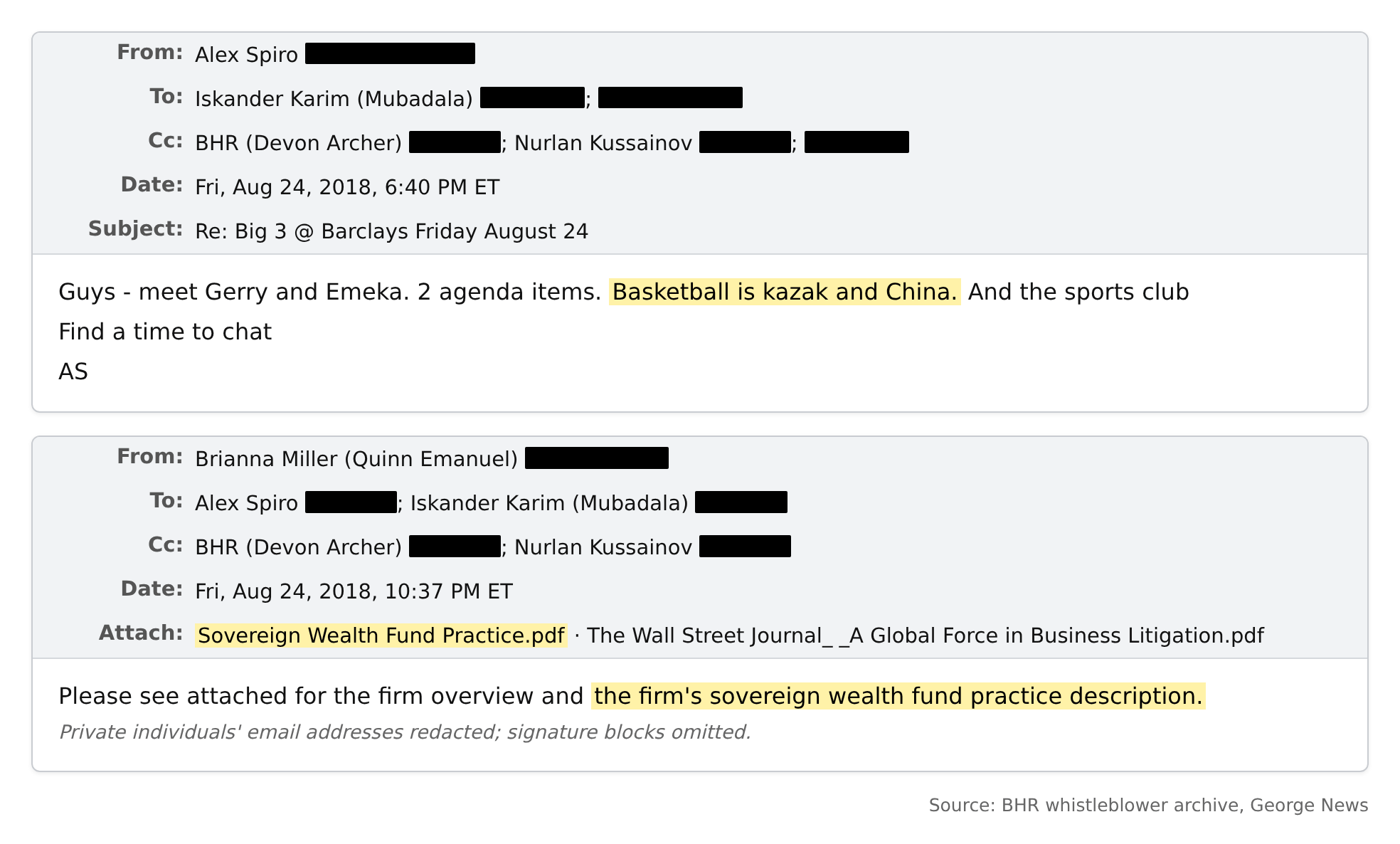
On August 24 Spiro wrote: “We will send you the firm 3 pager and the swf.” At 6:40pm he introduced two more people:
“Guys - meet Gerry and Emeka. 2 agenda items. Basketball is kazak and China. And the sports club”
At 10:37pm a Quinn Emanuel marketing director sent Karim and Kussainov “the firm overview and the firm’s sovereign wealth fund practice description.”
Pitching a law firm to a sovereign fund is ordinary business. But look where it went. April 13, 2019, Spiro to Archer: “We need to turn these contacts into something big.” January 25, 2020, a month before his BHR director paperwork: “Can’t believe we have failed to find a project.”
On March 18, 2020, at 9:42pm, Spiro introduced Archer to Scott Packman: “Scott- talk to Devon when you have a chance about spac and teaming up on some stuff.” On April 26, with Spiro copied, Packman asked Archer: “Just wanted to check in and see if you have an ETA on Henniges materials.” Henniges is the Michigan auto-parts maker BHR acquired alongside AVIC Automotive, as we laid out in Part III. We don’t know what the materials were for, or whether any deal followed.
On the To: line of a boardroom fight
By July 2020, BHR’s shareholders were fighting over the 2019 audit and the dividend. Spiro was on the To: line.
On July 9, Zhu circulated management’s answers to a shareholder’s audit questions. Item 3: “A subsidiary of BHR paid financial advisory fee of CNY1.94 million to BHR Newanchor Investment Management Ltd (“BHR Newanchor”), which is owned and controlled by 13 employees.” BHR said it was incentive pay managers had cut from their own salaries, sent offshore as “consulting service fees” to “motivate employees and achieve certain tax optimization.”
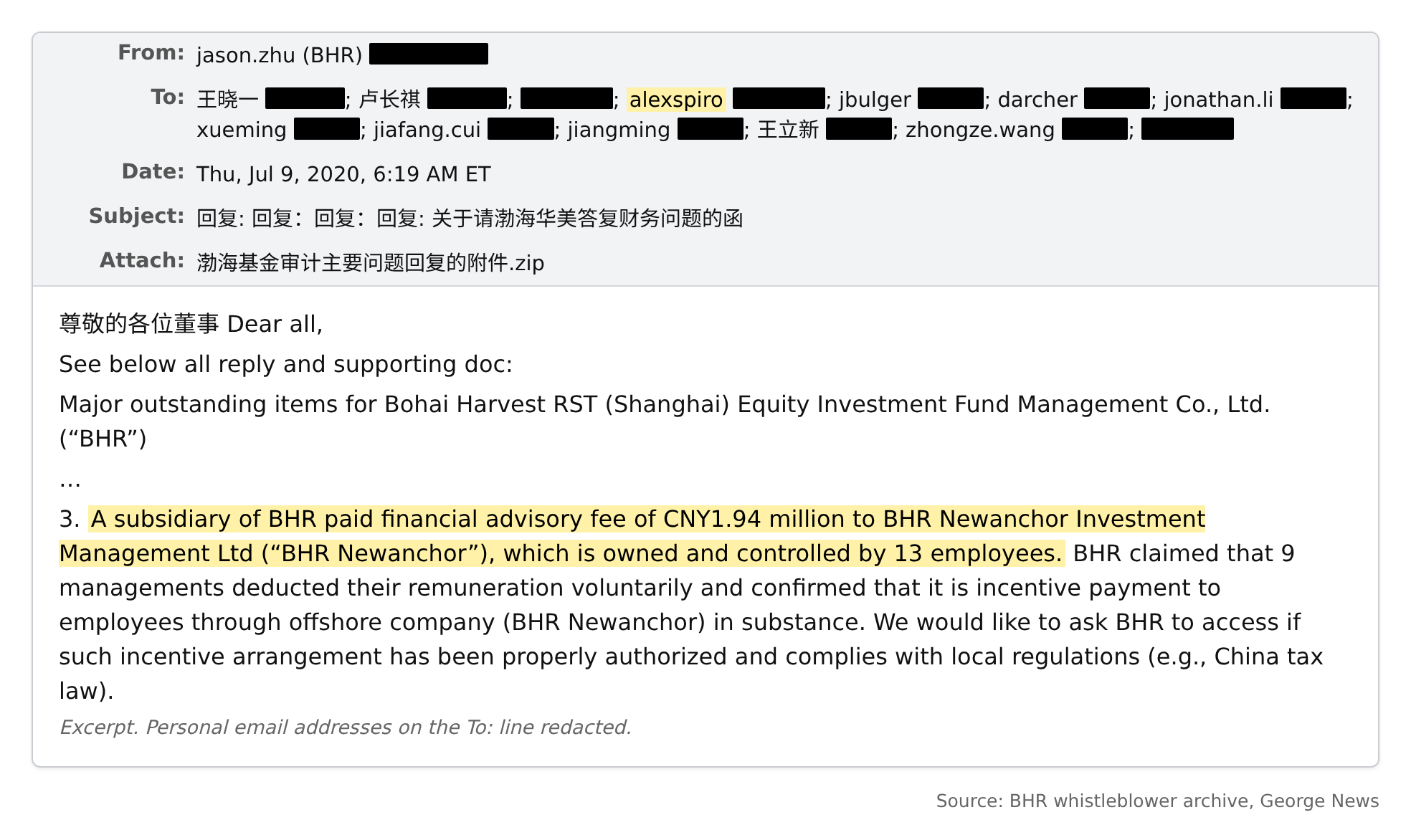
On July 14, Vice Chairman Lu Changqi told the board, Spiro included, that management would all resign (“将全体辞职”) if the chairman didn’t sign the audit report that day. We found no reply from Spiro. Being copied is not wrongdoing. But directors get these emails because directors are responsible.
The questions
For Mr. Spiro:
On April 28, 2020, who was “we” in “Are we part of the distribution?” What did “integrate me” mean?
Did you ever receive money, equity or any other benefit from BHR, Ulysses Diversified, or Devon Archer?
You signed the February 2020 Shanghai filing that put your name where Hunter Biden’s had been. Did you know whose seat you were taking? When did you stop considering yourself a BHR director?
What was the “50k” Krista Archer asked about on March 10, 2020?
Did you introduce any US investors, LPs or brands to the COFCO-BHR fund?
In November 2020 you wrote that you “never agreed for it to move forward.” How does that square with returning signed director filings and board resolutions, and asking BHR in June 2020 “how I could be useful”?
What was the SPAC you wanted Scott Packman to discuss with Archer?
For Quinn Emanuel:
Did the firm clear Spiro’s BHR directorship through its conflicts process?
Did the August 2018 sovereign wealth fund pitch lead to any engagement?
For Mr. Archer:
What was “our holdback”?
Who lent Ulysses the funds for its 2018 BHR investment, and why did “Chinese regulatory reasons” require them to come from the Ulysses account?
What was the 50k, and was it ever paid back?
Mr. Spiro, Quinn Emanuel, Mr. Archer: our inbox is open —we’ve sent you requests for comment.
If you’re new here, read what we published on Wednesday, then Part I, Part II and Part III.
Stay tuned, folks. More to come.
~GEORGE and Team